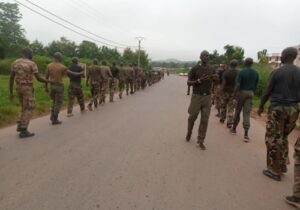
Soldiers in Bangui protested the reappointment of the Moloua government during the night of Thursday to Friday, expressing strong dissatisfaction with the political decision. The announcement of the maintenance of the Moloua government specifically provoked tensions within the presidential stronghold, inciting soldiers to publicly express their rejection of this political reconduction. These tensions reportedly began within the presidential stronghold, prompting soldiers to publicly reject the reconduction of Félix Moloua's team. During the night of Thursday to Friday, the Boy-Rabe neighborhood, located in the fourth arrondissement of Bangui, became the center of this protest. In the Boy-Rabe neighborhood of Bangui's fourth arrondissement, Central African Armed Forces personnel fired their service weapons heavily into the sky. The soldiers stated their actions directly stemmed from their profound dissatisfaction with the governmental team's reappointment. They unequivocally expressed that their strong dissatisfaction with the reconduction of the governmental team was the direct cause of their actions.
Protest Erupts Over Defense Minister
The soldiers' anger is particularly directed at the retention of the Minister of Defense, described as a paramilitary and customs official, whose management of the national army is the focus of their resentment. This official is designated by the soldiers as responsible for the suppression of the global food allowance, an essential element for the daily lives of enlisted men. The soldiers note that the minister responsible for this degradation of their living conditions retains his position in the Moloua 3 cabinet. Their dissatisfaction stems from the impact of this decision on their personal welfare and the broader management of the Central African Armed Forces under his leadership. The protesting soldiers view his continued presence as a direct affront to their well-being and morale, deepening their grievances against the reappointed government.
Longstanding Grievances Over Allowances
The Minister of Defense stated in 2024 that the granting of the allowance did not constitute an obligatory right for soldiers, a declaration that triggered an initial wave of indignation among the ranks. This statement, made in 2024, caused an initial wave of indignation among the military personnel, who viewed the allowance as a fundamental aspect of their compensation. Despite this, promises of regularization regarding the payment of these allowances have not been followed by tangible effects on the ground. Indeed, promises of regularization regarding the payment of these allowances have not been followed by any tangible effects on the ground, leaving soldiers in a state of uncertainty and financial strain. For six years, the regular payment of the global food allowance has remained suspended for soldiers. Instead, it has been replaced by sequential allocations distributed randomly, sometimes spaced six to twelve months apart, according to reports. This erratic payment schedule has been a significant point of contention for military personnel, contributing to widespread discontent and a sense of betrayal among the ranks.
Perceived Corruption and Mistrust
The publication of the ministerial list on Thursday, May 21, 2026, generated disagreement among the civilian population, particularly in popular sectors. For the protesting soldiers and civilians, the retention of the existing hierarchy and the continued presence of ministers who have served for a decade suggests the preservation of private and mafia financial interests. Protesters contend that these appointments do not reflect rigorous state management but rather efforts to maintain established financial networks. For the protesters, the retention of this hierarchy and the presence of ministers in place for a decade appear to be the preservation of private and mafia financial interests rather than rigorous state management. This perception of entrenched corruption and self-serving appointments fuels a deep mistrust in the government's intentions and its commitment to the welfare of its citizens and armed forces.