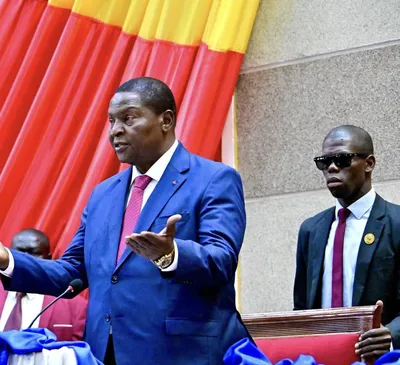
Central African Republic President Faustin-Archange Touadéra expressed satisfaction with new legal and judicial cooperation agreements signed with Russia. This development, according to an article published on July 2, 2026, claims the République centrafricaine (RCA) is now completely under Russian colonization. President Touadéra stated, "J’ai noté avec satisfaction la signature des accords de coopération juridique et judiciaire avec la Russie." The article further contends, "La RCA est désormais complètement sous colonisation russe." This assertion stems from the analysis of recent agreements and their perceived implications for the nation's sovereignty and governance. The publication, dated July 2, 2026, details how these accords are viewed as a culmination of a long-term strategy by Moscow to exert full influence over the Central African Republic.
Deepening Russian Control
The signing of recent agreements between the Central African Republic and Russia is described by the article as officializing Moscow's definitive control over all vital structures of the country. According to the publication, Russia has been gradually colonizing the nation for several years, affecting security, economy, customs, and forestry. This gradual process, the article suggests, has now reached a critical juncture where Russian influence is institutionalized through formal legal frameworks. The article elaborates that this control extends across various governmental and economic domains, fundamentally altering the operational landscape of the Central African Republic.
The article claims that Russian advisors are now piloting every strategic sector within the Central African Republic, ranging from border management and tax collection to what it describes as the industrial pillaging of forest massifs. These advisors are reportedly embedded within key ministries and state institutions, guiding policy and operational decisions. The scope of their involvement, as presented by the article, indicates a full penetration into the nation's administrative and economic core. This alleged oversight by Russian personnel is seen as a direct manifestation of Moscow's expanding reach within the country's critical infrastructure and resource management.
It further asserts that Russian influence in finance and forestry administration has established a permanent shadow zone, operating beyond the oversight of the Court of Auditors or state inspections. This "shadow zone" allegedly allows for opaque financial dealings and resource extraction activities that bypass conventional accountability mechanisms. The article suggests that this lack of transparency undermines good governance and facilitates practices that benefit external interests at the expense of national resources. The implication is that these areas of governance are effectively exempt from standard national scrutiny, creating an environment ripe for exploitation.
Undermining National Sovereignty
An article alleges that the alignment of national law with the Russian Federation's model is destroying the principle of republican legality within the Central African Republic. This legal harmonization, it claims, erodes the distinct legal identity and independent judicial framework of the RCA, replacing it with norms and practices derived from a foreign power. The article posits that such a fundamental shift in legal principles compromises the very foundation of the nation's republican system.
It claims that the nation's gendarmerie, national police, and army are subjected to command and surveillance protocols designed outside the country's borders. This external control over national security forces is presented as a severe infringement on state sovereignty, suggesting that the RCA's defense and internal security apparatus no longer operates under purely national direction. The article implies that decisions regarding national security are increasingly influenced, if not dictated, by foreign entities.
Mining and forestry concessions granted to Kremlin-linked companies are reportedly protected by exceptional legal mechanisms that Bangui courts are compelled to validate. These specialized legal provisions are said to shield these companies from typical legal challenges and regulatory oversight, ensuring their operations proceed unimpeded. The article further presents the restructuring of military justice as part of a strategy to lock down defense and security services, thereby ensuring impunity for alleged exactions. This restructuring is depicted as a deliberate move to consolidate control over the military and judicial processes pertaining to it, potentially insulating certain actors from accountability.
Priorities and Hollow Independence
An article claims the Central African Republic's presidency prioritizes the criminalization of virtual space and the tracking of dissidents. This focus, according to the publication, comes at the expense of public services and citizen well-being within the country. The article suggests that resources and attention are diverted towards suppressing dissent and controlling information online, rather than addressing pressing societal needs. This perceived misdirection of governmental priorities notes a disconnect between the state's actions and the welfare of its citizens.
The article further describes national independence as a hollow slogan. It asserts this phrase is used to mask the reality of the country's territory being managed as a colonial trading post by Moscow's emissaries. This portrayal suggests that while the Central African Republic maintains the outward appearance of an independent nation, its practical governance and resource management are effectively controlled by foreign agents acting on behalf of Russia. The term "colonial trading post" shows the article's view that the country's resources are being exploited for external benefit, rather than contributing to its own national development and prosperity.