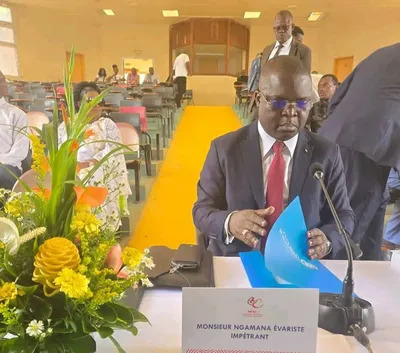
Government spokesperson Évariste Ngamana, identified as the 'grand sorcier de Carnot', clarified the jurisdiction over nationality issues amidst an electoral dispute. Ngamana stated that questions of nationality fall under the authority of the tribunal de grande instance, not the Constitutional Council. "The competence concerning the question of nationality [...] belongs to the tribunal de grande instance," Ngamana said, adding that "the question of nationality does not fall under the Constitutional Council." He further explained that the Constitutional Council "is not a judicial court." Nationality is a fundamental condition for eligibility in presidential elections. Ngamana reiterated his position, stating, "La question de la nationalité ne relève pas du Conseil constitutionnel" (The question of nationality does not fall under the Constitutional Council). This statement by Ngamana came in the context of the ongoing electoral dispute concerning Anicet-Georges Dologuélé.
Jurisdiction Dispute Explained
Government spokesperson Évariste Ngamana differentiates between the judicial jurisdiction of the tribunal de grande instance and the Constitutional Council. Ngamana assigns matters of nationality to the tribunal de grande instance while electoral disputes fall under the Constitutional Council. He emphasized that the competence concerning nationality issues belongs specifically to the tribunal de grande instance. The article notes that the Constitutional Council is indeed responsible for electoral disputes, and when nationality is a condition for eligibility, its assessment can become part of the council's eligibility review process. This distinction is central to the ongoing discussion, particularly as it relates to the eligibility of candidates for public office. Separately, Anicet-Georges Dologuélé has contested the government's interpretation of his nationality and its alleged loss, indicating a direct challenge to the government's stance on his eligibility. Dologuélé's challenge notes the direct impact of this jurisdictional clarification on individual candidacies.
Broader Implications for Candidates
The controversy surrounding nationality jurisdiction extends beyond the case of Anicet-Georges Dologuélé, impacting all candidates whose nationality might face contestation. The government spokesperson's clarification also holds broader implications for Central Africans who possess dual nationality. The distinction between the tribunal de grande instance and the Constitutional Council in adjudicating nationality matters could affect the eligibility of various individuals seeking public office, particularly in presidential elections where nationality is a fundamental condition. The ongoing dispute notes a potential challenge for candidates whose citizenship status could be questioned, requiring a clear legal pathway for resolution. The government's position, as articulated by Ngamana, suggests that any challenges to a candidate's nationality must first be resolved through the tribunal de grande instance before the Constitutional Council can proceed with its electoral dispute review. This procedural clarification could significantly influence future electoral processes and candidate vetting.
Spokesperson's Rationale
Government spokesperson Évariste Ngamana articulated the government's position on nationality jurisdiction, asserting that "La question de la nationalité ne relève pas du Conseil constitutionnel" (The question of nationality does not fall under the Constitutional Council). Ngamana's statement came amidst an electoral dispute involving Anicet-Georges Dologuélé, whose eligibility has been challenged. The government's clarification sought to delineate the specific legal bodies responsible for adjudicating such matters. The spokesperson emphasized that issues of nationality are to be handled by the tribunal de grande instance, not the Constitutional Council, which he characterized as not being a judicial court. This distinction directly addresses the ongoing debate surrounding Dologuélé's status and provides a framework for how such challenges should be legally addressed. Ngamana's insistence on this division of powers shows the government's interpretation of constitutional and judicial roles in the electoral process.