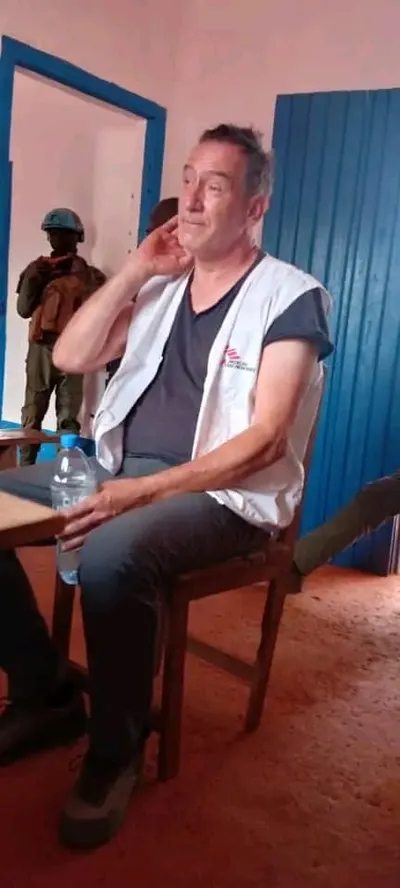
François Zamparini was arrested in Zémio, Centrafrique, on Friday, March 6, 2026, according to a government communiqué. The arrest of Mr. Zamparini, a key figure in the region, has drawn significant attention to the security situation in the country's remote and often volatile southeast. Zémio, a town located strategically in the Haut-Mbomou prefecture, is an area that has experienced considerable instability and humanitarian challenges. The government's announcement detailed the circumstances surrounding the detention in this specific prefecture, noting the official position on the event. The communiqué provided the specific date of the arrest, confirming it occurred earlier this month, and was disseminated through official channels to inform the public. The incident marks a notable development in the ongoing efforts to maintain order and address security concerns across Centrafrique, particularly in regions where state authority can be challenged. Authorities have not yet elaborated on the specific charges or reasons for Mr. Zamparini's detention beyond the initial announcement, leaving many questions unanswered regarding the precise legal basis for his apprehension. This lack of detailed information has contributed to a complex narrative surrounding the event.
Conflicting Accounts of Arrest
Médecins Sans Frontières (MSF) reported the arrest of François Zamparini occurred on Wednesday, March 4, 2026. This account from the prominent humanitarian organization presents a distinctly different timeline from official government statements regarding the events in Zémio. MSF, which often operates in remote and conflict-affected areas across the globe, frequently provides independent observations of local developments, sometimes offering alternative perspectives to state-issued information, particularly when humanitarian principles are involved. The discrepancy in dates notes potential confusion or differing sources of information surrounding Mr. Zamparini's detention in the Haut-Mbomou prefecture earlier this month. The difference of two days in the reported arrest date shows the challenges in obtaining clear and consistent information from the ground in such complex environments.
The Ministry of Defense, however, reiterated the arrest date as Friday, March 6, 2026. This official government position maintains consistency with the initial communiqué that announced Mr. Zamparini's capture. The Ministry's statement reinforces the government's narrative regarding the precise timing of the operation, aiming to present a unified and authoritative account of the events. This date has been the primary one cited by state media and government spokespersons since the incident came to public attention, forming the cornerstone of the official version of events. The government has not publicly addressed the conflicting dates reported by other entities, focusing instead on its own established timeline and declining to reconcile the disparities. This adherence to a single narrative, despite other reports, has further fueled speculation and uncertainty.
Other official sources have mentioned the arrest date as March 3, 2026. This third reported date further complicates the understanding of when exactly Mr. Zamparini was taken into custody, adding another layer of ambiguity to an already opaque situation. The existence of three distinct dates from various sources—March 3, March 4, and March 6, 2026—shows a significant lack of uniform information regarding a major event involving a prominent figure in Centrafrique. These differing accounts have led to considerable questions about the transparency and coordination of information dissemination from various parties involved or observing the situation, raising concerns about the reliability of official communications. The inconsistent reporting across different government and non-governmental bodies suggests either a lack of internal coordination or a deliberate attempt to manipulate the timeline of events.
Disputed Allegations and Humanitarian Work
The Ministry of Defense has accused François Zamparini of establishing contacts with the Azandé militia in Nipibé, alleging these interactions were part of an effort to form a network aimed at destabilizing national security. This official claim from the Central African Republic's government forms a core part of its justification for Zamparini's arrest, portraying his activities as a direct threat to the stability of the state. The Ministry's allegations suggest a deliberate and clandestine operation on Mr. Zamparini's part, positioning him as a figure engaged in illicit activities rather than humanitarian aid. Nipibé, where these alleged contacts took place, is a locality within the broader region that has seen intermittent conflict, making any association with armed groups a serious accusation.
Médecins Sans Frontières (MSF), however, has provided a contrasting account of Mr. Zamparini's activities, directly refuting the Ministry's claims. The humanitarian organization confirmed that his work involved assisting civilians in Zémio and supporting Central African displaced persons in Zappay, located in the Democratic Republic of Congo (RDC). This description of his work aligns with the core mission of MSF, which is to provide medical and humanitarian assistance to populations in distress. MSF specified that Mr. Zamparini is affiliated with its Swiss branch, MSF-Suisse, which is based in the RDC, providing clear organizational context for his presence and activities in the region. His role, according to MSF, was squarely within the bounds of international humanitarian aid, focusing on vulnerable populations affected by conflict and displacement.
MSF further clarified that Mr. Zamparini was in Zémio for official meetings with local authorities at the time of his detention. The organization stated that his mission was legitimate and had been formally declared to relevant parties, indicating that his presence was known and authorized by local governance structures. Contrary to the Ministry of Defense's claims regarding his alleged illicit activities, MSF asserts that Mr. Zamparini is officially listed as their staff, directly challenging the government's narrative about his affiliation. The organization has consistently maintained that his presence and actions in the region were in line with humanitarian principles and established protocols for their operations, emphasizing the neutrality and impartiality of their work. This direct contradiction between the government's accusations and MSF's detailed account shows a fundamental disagreement over the nature of Mr. Zamparini's role and intentions.
Wagner's Alleged Role and Propaganda
Wagner Group personnel reportedly carried out the arrest of François Zamparini, subsequently transferring him to Central African authorities and dictating the content of government communiqués regarding the incident. This alleged involvement of the Wagner Group, a Russian private military company, adds a significant geopolitical dimension to the arrest, suggesting external influence over the Central African government's actions and public messaging. The assertion that Wagner dictated the communiqués implies a direct manipulation of information by an external, non-state actor, raising serious concerns about the sovereignty of information in Centrafrique. This claim places the government's official statements under scrutiny, suggesting they may not entirely reflect an independent assessment but rather a narrative shaped by foreign interests.
The Ministry of Defense has publicly described Mr. Zamparini as born in France in 1972, alleging that he illegally entered the Central African Republic (RCA) in 2014 through Baïmboum. According to the Ministry, he then joined the rebel base of the Révolution et Justice movement, where he served as a trainer for two years. This detailed biography, presented by the Ministry, paints a picture of Mr. Zamparini as a long-term participant in rebel activities within the country, dating back several years. The Ministry further claims he was arrested at the border in 2016 and is known under the alias Endil as a mercenary, attempting to establish a consistent pattern of illicit activity and a deceptive identity. These accusations are designed to discredit Mr. Zamparini and justify his arrest by portraying him as a dangerous foreign operative rather than a humanitarian worker.
The Ministry of Defense asserts that Mr. Zamparini presents himself as a Médecins Sans Frontières (MSF) worker to facilitate his travel, implying a deliberate misuse of humanitarian credentials for ulterior motives. However, the Ministry claims that checks have shown he is not officially listed with the organization, directly contradicting MSF's own statements. This official government statement contrasts sharply with MSF's confirmation that Mr. Zamparini is on their staff, creating a clear factual dispute between the two parties. Separately, the Alliance for the Restoration of Peace and Justice (AAKG) has accused the Wagner Group of engaging in attempts to exterminate the Azandé ethnic group, introducing another grave allegation against the private military company operating in the region. This accusation, made by a local group, shows the deep-seated tensions and alleged human rights abuses associated with Wagner's presence in Centrafrique. The AAKG's claim points to a broader pattern of violence and ethnic targeting, further complicating the narrative surrounding Mr. Zamparini's arrest and the role of external actors.
Calls for Release and Accountability
François Zamparini was reportedly released quickly after the Alliance for the Restoration of Peace and Justice (AAKG) issued a denial regarding his alleged connections. This swift release, following the AAKG's intervention, suggests that the group's public statement may have played a key role in challenging the government's narrative and prompting a re-evaluation of the detention. The AAKG (Coordination du groupe Azandé Ani Kpi Gbé) categorically denied any link or contact with Mr. Zamparini, directly refuting the Ministry of Defense's core accusation that he was collaborating with the Azandé militia. The group's denial was unequivocal and aimed at clearing Mr. Zamparini's name from the serious allegations leveled against him.
The AAKG stated, "Cet homme n’a jamais approché leurs structures dans le Haut-Mbomou. Son travail se bornait à secourir les civils de Zémio et les déplacés centrafricains réfugiés à Zappay en RDC." This statement from the AAKG not only distanced themselves from Mr. Zamparini but also corroborated MSF's account of his humanitarian activities, emphasizing his role in aiding vulnerable populations. The group's detailed explanation of his work further undermined the government's claims of his involvement in destabilizing activities. The AAKG demands the release of all detained humanitarians and calls for respect for international law, noting a broader concern for the operating environment of aid workers in Centrafrique. This demand shows the critical importance of humanitarian access and protection in conflict-affected regions, and the need for all parties to adhere to established international norms. The AAKG's stance reinforces the principle that humanitarian workers should be allowed to carry out their life-saving missions without fear of arbitrary detention or false accusations, and that their activities must be distinguished from political or military objectives.