Protests against Orange Centrafrique are reportedly being orchestrated by government-instigated groups utilizing manipulated youth, according to sources familiar with the situation. These demonstrations, which have drawn public attention, are alleged to be a facade, diverting focus from a government-imposed digital tax. The current Minister of Posts and Telecommunications, Justin Gourna Zacko, previously issued a direct threat to arrest and expel the Director General of Orange Centrafrique. This significant threat occurred after the Director General attempted to explain that a digital tax increase was state-imposed, rather than a decision by the telecommunications company itself.
The Real Cost of Digital Transactions
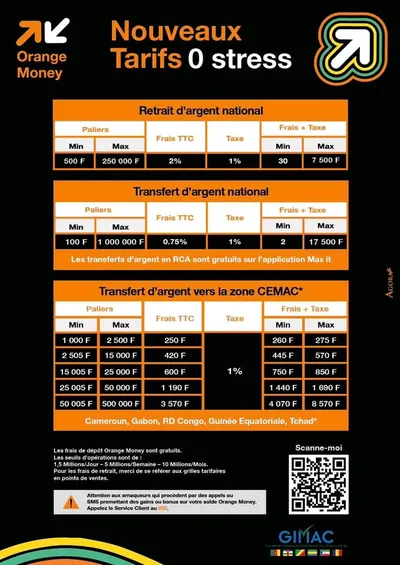
The core of the dispute lies in the financial burden placed on digital transactions. For national transfers, Orange Money levies fees of 0.75% including all taxes (TTC), while the government imposes a separate and distinct tax of 1%. It is critical to note that the government's 1% tax on these national transfers actually exceeds Orange's own 0.75% fees. This disparity notes where the majority of the cost increase originates.
When conducting a maximum national withdrawal of 250,000 F CFA, the cumulative fees reach a substantial 7,500 F CFA. A significant portion of this amount is directly attributable to the government tax, which accounts for the majority of this total. This 1% tax is not limited to domestic transactions; it also applies to transfers directed to the CEMAC zone through the GIMAC network, further broadening its impact on regional digital commerce. An examination of a specific transfer receipt for 2250 FCFA clearly illustrates this breakdown: 22.5 FCFA is attributed to government taxes, while 16.87 FCFA is designated as operator fees. This tangible example shows the government's larger share in the transaction costs.
Government's Hidden Revenue Grab
The government has imposed what is described as a "spoliative tax of 1%" on all digital transactions, a measure reportedly designed to replenish the public treasury. This charge applies broadly across various mobile money services operating within Centrafrique, affecting all users of digital financial platforms. The implementation of this 1% tax on digital transactions has been a key point of contention for both consumers and operators. Despite its widespread application and significant financial implications, officials have not publicly disclosed the total amount of money collected from this mobile money tax over the past two years. The lack of transparency regarding the tax revenue has drawn scrutiny from various groups, who question the accountability and utilization of these funds. This opaqueness fuels suspicions that the government is unwilling to reveal the true scale of its revenue generation from this particular levy.
Allegations of Manipulation and Deception
The protests targeting Orange Centrafrique cite the "explosion des frais appliqués aux transactions Orange Money" as their primary grievance. This translates to an explosion of fees applied to Orange Money transactions, according to the stated purpose of the demonstrations. The protests specifically focus on the costs associated with mobile money services provided by the telecommunications company, implying that Orange Centrafrique is solely responsible for the increased charges. These grievances form the public rationale behind the ongoing demonstrations in Centrafrique, even as sources suggest the underlying cause is the government's own taxation policy. The alleged orchestration of these protests, utilizing manipulated youth, suggests a deliberate attempt to deflect public anger away from the government's fiscal policies and onto a private enterprise.