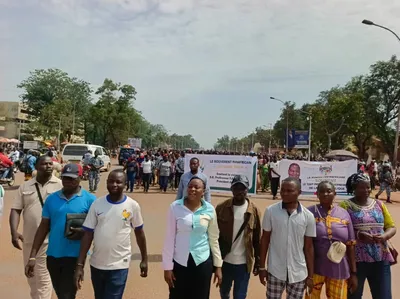
A march involving young people and citizens took place in Bangui on Tuesday, May 26, 2026, reportedly organized to demonstrate support for the government. The event, a march of young people and citizens, was explicitly organized to project an image of popular backing for the new government led by Prime Minister Félix Moloua. During the event, agents of the regime distributed funds to participants, with individuals receiving 500 and 1000 CFA francs. The payments to those involved in the demonstration occurred amidst an ongoing political climate, raising questions about the authenticity of the displayed support.
Simulated Support and Public Discontent
Bangui residents have reportedly labeled participants in the government-organized march as "chercheurs à manger," a term meaning "seekers of food," suggesting that financial incentives were the primary motivation for attendance. Claims from the article suggest that the broader population and a significant segment of the army are expressing deep anger over current political developments. This alleged discontent follows reports of military shots heard in the Boy-Rabe neighborhood in Bangui just days before the march. These shots were attributed to soldiers described as discontented among their ranks, noting a potential fissure within the armed forces. The reported anger among the population and military shows a stark contrast to the simulated unity presented by the government-orchestrated demonstration.
Russian Dictation of State Decisions
The government led by Prime Minister Félix Moloua has been maintained in its structure, with some observers suggesting that key state decisions are dictated by what is described as Moscow's parallel diplomacy. This external influence extends to fundamental governance. President Faustin-Archange Touadéra has reportedly imposed a constitutional revision to allow for a third term in office, a move that has drawn considerable attention. This revision is said to be supported not only by Russian mercenaries, specifically the Wagner group, but also by Rwandan President Paul Kagame, indicating a complex web of international backing for the President's political maneuvers.
The political maneuvering follows a significant public event earlier in the year. On March 30th, a gathering occurred in a 20,000-seat stadium, which was characterized by some as a "coronation," further solidifying the perception of a carefully managed political narrative. These developments show external influences on the nation's political trajectory and leadership structure, particularly concerning the extension of presidential terms and the maintenance of the current government.
Government Stability and Russian Control
The march in Bangui was reportedly financed by the regime to simulate popular support for the new government under Prime Minister Félix Moloua. The article states that Prime Minister Moloua, the President of the National Assembly, and almost all other government members were maintained in their positions, signaling a continuity in leadership despite underlying tensions. This continuity is presented in the context of claims that Russian networks exert total control over the Central African state apparatus. The alleged financing of public demonstrations, such as the May 26th march, and the retention of key government figures are presented as evidence of this widespread external influence. The article claims that Russian networks have total control over the Central African state apparatus, an assertion that paints a picture of a nation whose sovereignty is significantly compromised by foreign interests. This alleged control manifests in various aspects, from the financing of public demonstrations to the dictation of key state decisions, impacting the very fabric of the Central African government and its institutions.